Happy Wheels
- 4.3
- Rating
- 10.00M
- Installs
- Free
- Price

 Analysis by App-foxy
Happy Wheels is the kind of racing game I open when I want something quick, strange, and much less predictable than a standard driving title. Instead of focusing on polished cars, realistic tracks, or clean finishes, it puts me in side-scrolling obstacle courses where momentum, timing, and an often-unfortunate character body all matter at once. The result is funny, tense, and occasionally brutal.
Developed by James Bonacci, it is available as a free game, with optional in-app purchases priced at $1.99 per item. That makes the initial decision easy: you can try the core experience without paying upfront. The more important question is whether this unusual physics challenge suits your patience, your sense of humor, and the way you like to play racing games.
What playing Happy Wheels actually feels like
My first impression is that this is not really a traditional racing game, even though it belongs in the racing category. There is no need to think of every course as a contest against other drivers. The real challenge is surviving a route filled with hazards while keeping control of a vehicle and rider whose movements can quickly become awkward. A small mistake can turn a careful attempt into a spectacular crash.
You May Also Like

 Blood Strike: 2.5 Anniversary
Blood Strike’s Loadouts Turn Every Drop Into a Tactical Gamble
A close look at Blood Strike’s custom loadouts: how fast access to signature weapons reshapes its battle royale rhythm, rewards preparation, and narrows the gap between fights.

 Pandora - Music & Podcasts
Pandora’s Music Is Easy to Start, but Harder to Recover
Pandora’s strength is its low-effort path from a seed to a station. Its weak spot is how much confidence it asks you to place in connection, setup, and quiet recovery.

 8 Ball Pool
 Is Built on Rivalries, Rematches, and Routine
A close look at the rivalries, rematches, shared routines, and unanswered safety questions that turn a quick pool match into a persistent mobile community.

 Samsung Music
’s Quiet Strength Is Playing What You Already Own
Its reach comes less from spectacle than from dependable access to a personal library. That simplicity is both the app’s strongest retention engine and its ceiling.

 AccuWeather: Weather Radar
AccuWeather Review: A Quick, Clear Forecast for Everyday Decisions
For everyday plans, the best forecast is the one you can understand quickly. AccuWeather makes rain timing, radar, and local conditions easy to act on, with a few trade-offs.

 Hill Climb Racing
Why Hill Climb Racing Still Turns Crashes Into One More Run
A tiny car, a bumpy hill and one more upgrade: Hill Climb Racing keeps resurfacing because its simple chaos makes every near-miss feel personal.
More From Our News Desk



The side-on view is important because it makes the action easy to read. I can see upcoming obstacles, judge the shape of a slope, and decide whether to accelerate, slow down, or reposition myself. That simplicity is deceptive. The controls may look approachable, but the physics punish careless movement. Holding a direction for too long can be just as damaging as reacting too late.
What keeps me playing is the gap between knowing what I should do and actually doing it. I might understand that a ramp needs a controlled approach, yet still arrive with the wrong angle. I might clear the first hazard and then lose balance on the landing. Those failures are usually immediate enough to teach me something, which makes restarting feel worthwhile rather than pointless.
The game also has a deliberately dark sense of comedy. The violence is exaggerated and tied closely to the physics, so crashes become part of the entertainment rather than a minor side effect. That tone explains the Mature 17+ content rating. I would not hand it to a young child simply because the visuals look cartoon-like; the presentation and subject matter are aimed at older players.
Why the physics are the main attraction
In many racing games, the vehicle is a tool that behaves consistently. Here, the rider and vehicle feel connected in a much more fragile way. Balance, speed, slopes, and obstacles interact constantly. The best runs are not always the fastest ones. A slower approach can preserve control, while a burst of speed can create enough momentum to clear a gap but leave no room for recovery.
That creates a useful habit: I stop treating acceleration as the automatic answer. Before a difficult section, I look at the landing rather than only the obstacle itself. If the next surface is narrow or uneven, arriving with too much speed can be worse than failing to clear the first part. This is one of the game’s less obvious lessons, and it is why repeated attempts can feel like practice instead of random punishment.
Another tip is to make small corrections whenever possible. Large, panicked inputs often produce a chain reaction. A modest adjustment can keep the rider aligned, especially when the vehicle is already moving in the right direction. I found that the game rewards restraint more often than frantic movement, even when the screen encourages me to react quickly.
There is also a psychological trade-off in the physics. Because the outcome can change after a tiny error, success feels earned, but the same quality can frustrate anyone looking for smooth, relaxing progress. Happy Wheels is at its best when I am willing to laugh at a failed attempt and try again. It is much less enjoyable if I expect every restart to feel fair in a conventional racing-game sense.
How I approach a difficult course
When a route repeatedly defeats me, I do not immediately try to go faster. I divide it into sections. First I work out how to approach the opening hazard. Then I pay attention to the landing and the next transition. This turns a long, chaotic course into a series of smaller problems. It also helps reveal whether I am failing because of speed, positioning, or a poor reaction after landing.
A practical everyday scenario is a short break during a commute or between tasks. I can play a few attempts, fail quickly, and put the game down without needing to remember a complicated story or a large set of objectives. That convenience is a real strength. At the same time, a short session can become longer than planned because one nearly successful run makes me want another try.
I also recommend learning to recognize when a failure was useful. If the rider reaches the obstacle but lands badly, the next attempt should change the approach rather than repeat it exactly. If the vehicle never reaches the required height, then a more aggressive start may be necessary. Treating every crash as identical wastes time; the physics give clues if I watch the whole attempt instead of focusing only on the final impact.
Cost, value, and the compromises behind the free entry
The basic financial appeal is straightforward: the game is free to download and play, while optional purchases cost $1.99 per item. I appreciate that this lets a curious player test the unusual design without committing money first. The free entry is especially useful here because Happy Wheels is not a conventional racing experience. Some people will enjoy its physics immediately, while others will find the crashes and awkward control too irritating.
I would not describe the purchase model as a reason by itself to choose the game. The value comes from whether the core challenge keeps you interested. If you enjoy experimenting with movement, repeating a section until your timing improves, and treating failure as part of the joke, the free access provides a sensible way to find out. If you dislike trial-and-error gameplay, paying for optional items is unlikely to change the underlying style that may be bothering you.
The game has attracted a sizable audience, with an average rating of 4.3 from around 372 thousand ratings and more than 10 million installs. Those figures suggest broad interest, but they do not remove the need to consider the game’s tone and difficulty. A popular title can still be a poor match for someone who wants calm driving, realistic handling, or a clear progression path.
Its current version is 1.1.3, and it requires Android 6.0 or later. For a person using an older device or operating system, compatibility should be checked before planning to play. For supported devices, the low entry cost makes experimentation easy, but the Mature 17+ rating remains just as relevant as the price.
Where the game delivers more value than expected
The strongest value is replay value created by problem solving rather than by a realistic simulation. I can return to a difficult section with a different idea: change the approach speed, manage the landing, or make a smaller correction. That kind of experimentation gives the game a longer life than its simple side-on presentation might suggest.
It also works well for sharing a quick laugh with friends, even when nobody is taking turns in a formal competition. A surprising crash or an almost successful attempt can become the point of the session. The game is therefore useful in social situations where people want something immediately understandable, but not necessarily something serious or polished.
Another less obvious strength is that the game makes me notice transitions. In a conventional racer, I often focus on the next bend or the fastest line. Here, the moment where one surface changes into another can be more important than the obstacle itself. Watching how the vehicle lands and settles teaches a kind of visual timing that is specific to this physics-driven design.
There is value for players who enjoy short loops of attempt, observation, adjustment, and retry. The game does not need to provide a long narrative to hold attention because each run supplies a small experiment. That is a good fit for mobile play, especially when I want an activity that can begin immediately and does not require a large time commitment.
Trade-offs that should influence your decision
The same physics that make the game distinctive can make it feel inconsistent if I approach it with normal racing expectations. A precise-looking input may not produce the clean result I imagined because the rider’s position and the vehicle’s movement are connected. This is not necessarily a flaw, but it means the learning curve is based on feel and repetition rather than on memorizing a simple braking point.
The dark humor is another clear dividing line. Some players will find the exaggerated crashes entertaining; others will find them unpleasant or simply tiring. The Mature 17+ rating is not a detail I would ignore. If you want a family-friendly racing game, a colorful kart racer or a gentler arcade title would be a better choice.
I also would not recommend it to someone seeking a serious motorsport experience. It does not appeal to the same desire as a simulator with careful car setup, realistic tracks, and consistent vehicle handling. A conventional arcade racer is preferable if your main goal is to drift, overtake opponents, or build a sense of speed through polished courses.
There is a patience cost as well. A failed run can be funny the first time, but repeated failures may become exhausting when progress depends on a narrow sequence of movements. My best sessions happen when I set a small goal, such as getting past one troublesome section, rather than expecting a perfect run immediately.
Who will get the most from it?
I think Happy Wheels is best for players who enjoy unusual physics, dark slapstick, and obstacle-course challenges more than conventional racing structure. It suits people who like learning through mistakes and who can accept that a successful attempt may require several awkward failures first.
It is also a good option for someone who wants a free way to sample a distinctive game before spending anything. Since optional purchases are $1.99 per item, the initial trial matters more than a promise of premium value. I would play the free version long enough to decide whether the physics feel amusing or annoying before considering any optional purchase.
Players should skip it if they need gentle controls, a relaxed mood, or a predictable sense of progress. It is not my recommendation for children because of the age rating, and it is not the right substitute for a polished racing simulator. Someone who wants a quick, chaotic challenge may love it; someone who wants clean laps and reliable handling probably will not.
For an older player with a few minutes to spare, the game can fit naturally into everyday routines. I can start a run while waiting for an appointment, attempt one obstacle several times, and stop without losing the thread of a story. The risk is that “one more attempt” becomes a longer session, particularly after reaching a section that seemed impossible a moment earlier.
My verdict on downloading it
My recommendation is positive, but specific. Download Happy Wheels if you want a free, physics-heavy obstacle game with dark humor and a willingness to make failure entertaining. The combination of side-scrolling visibility and unpredictable movement gives it a personality that ordinary racing games do not have.
I would skip it if your definition of racing requires smooth handling, realistic vehicles, or competition built around clean finishing times. The game’s appeal is not polish in that traditional sense. It is the strange satisfaction of understanding why a run failed, changing one decision, and watching the next attempt unfold differently.
The free price makes that recommendation easier because you can judge the experience directly rather than guessing from screenshots. Optional purchases are available at $1.99 per item, but I would treat them as secondary to the question of whether the core physics loop works for you. If the crashes make you laugh and the retries make you curious, the game offers strong value without an upfront payment.
After spending time with it, I see it less as a normal racer and more as a compact physics playground disguised as one. That distinction is the key to enjoying it. Approach it as a serious driving contest and it may feel chaotic; approach it as a challenge built around momentum, balance, and comic disaster, and Happy Wheels becomes an easy game to revisit whenever I want a quick, unpredictable break.
FAQs for Happy Wheels
01What is Happy Wheels, and how does the game work?
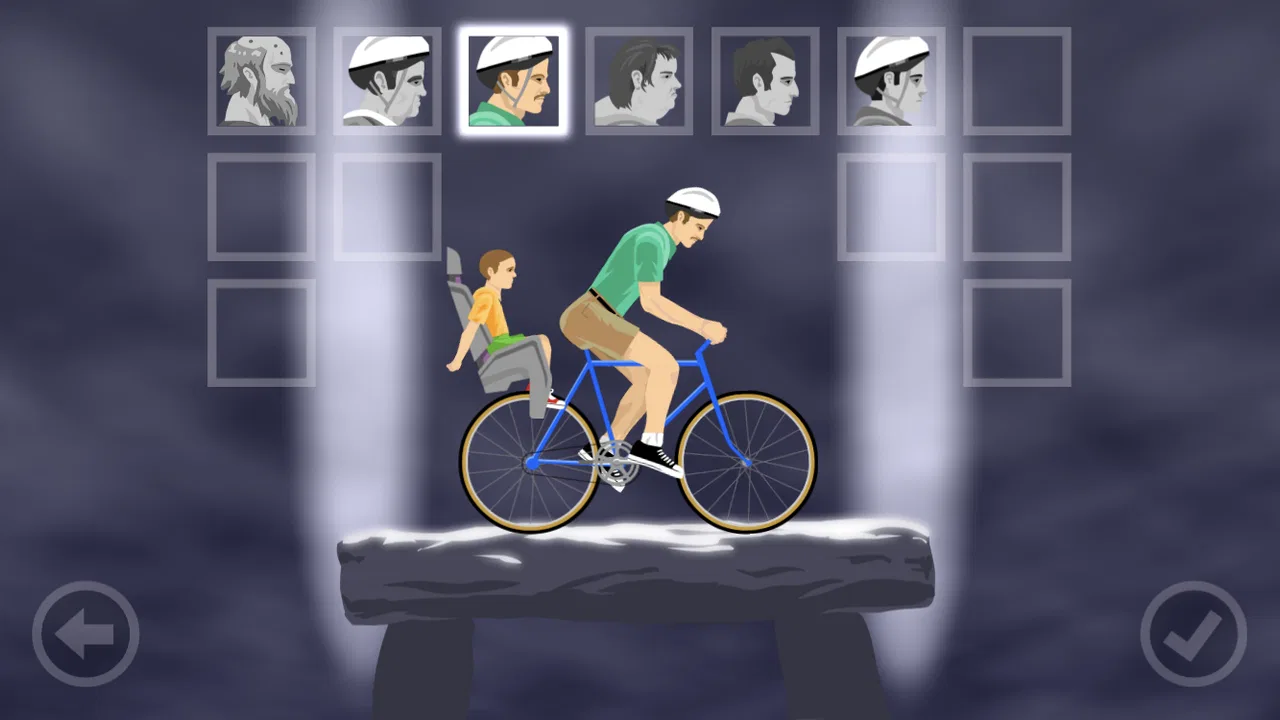
Happy Wheels is a physics-based obstacle-course game in which you control unusual characters riding wheelchairs, bicycles, segways, and other vehicles through dangerous levels. The goal is usually to reach the finish line while avoiding spikes, mines, traps, and other hazards. Its appeal comes from unpredictable physics, humorous animations, and user-created levels rather than a traditional story or campaign.
02Is Happy Wheels suitable for children?
Happy Wheels has cartoon-style graphics, but it includes exaggerated injuries, blood, crashes, and dark humor. Because of this, it may not be appropriate for young children or players who are uncomfortable with violent-looking physics effects. Parents should check the store rating, review the available content, and consider whether the game’s mature humor and graphic accident animations are suitable before allowing a child to download it.
03Does Happy Wheels require an internet connection to play?
The basic gameplay experience can generally be enjoyed without a constant internet connection, especially when playing levels that are already available on the device. However, online features such as browsing, downloading, or sharing user-created content may require internet access. Availability can also differ depending on the version and platform, so it is worth checking the app’s current store description before relying on offline play.
04Does Happy Wheels include user-created levels?
User-created content is one of the most important parts of the Happy Wheels experience. Players can discover levels designed by other members of the community, ranging from clever obstacle courses to chaotic experimental challenges. Quality varies considerably, and some levels may contain stronger humor or graphic elements than others. An internet connection and access to the relevant community features may be needed to browse or load this content.
05Are there advertisements or in-app purchases in Happy Wheels?
The presence of advertisements, optional purchases, and other monetization features can depend on the official version, platform, and current store release. Before downloading, check the Google Play or App Store listing for updated information about ads, purchases, and age ratings. If the game offers optional payments, review them carefully, particularly when the device is shared with children, and use parental controls where appropriate.
Pros
- Creative physics-based levels with plenty of surprising moments.
- Large collection of user-made stages adds variety and replay value.
- Simple controls make the game easy to pick up quickly.
- Distinct characters and vehicles offer different gameplay styles.
- Short levels work well for quick gaming sessions.
Cons
- Frequent crashes and graphic injuries may not suit younger players.
- Some user-created levels feel unfair or poorly balanced.
- Touch controls can be awkward during precise vehicle movements.
- Progress may feel repetitive once familiar with the main mechanics.
- The game can include ads that interrupt the playing experience.

Happy Wheels
Gallery